Starlink Kenya: Still the Best for Fast, Reliable Internet
In a rapidly digitizing world, reliable internet connectivity has become as essential as electricity or water for many Kenyans. From bustling urban centers like Nairobi to remote rural villages in Turkana, the demand for high-speed, low-latency internet continues to soar. As of September 2025, Kenya’s internet penetration stands at over 60%, fueled by innovations in e-commerce, telemedicine, online education, and remote work. However, challenges like uneven infrastructure, high costs, and inconsistent service persist, particularly in underserved areas. Enter Starlink, SpaceX’s revolutionary satellite internet service, which has been transforming Kenya’s digital landscape since its official launch in 2023.
Despite the emergence of competitors and expansions in traditional fiber and mobile networks, Starlink remains the frontrunner for many users. Why? Its unique satellite-based technology offers unparalleled coverage, speed, and reliability, especially where other providers fall short. In this comprehensive 2,500+ word article, we’ll explore the reasons Starlink is still the best internet option in Kenya, drawing on its technological edge, real-world impact, pricing advantages, and robust local support ecosystem. We’ll also highlight authorized resellers like Starlite Internet Kenya, Spacelink Kenya, and Starlink Kenya, who make accessing this cutting-edge service seamless for Kenyans.
Kenya’s Internet Landscape: The Need for a Game-Changer
Kenya has made remarkable strides in digital connectivity. The Communications Authority of Kenya (CAK) reports that by mid-2025, the country boasts over 50 million internet users, with mobile data dominating at 85% of connections. Providers like Safaricom, Airtel, and Zuku have expanded 4G/5G networks and fiber optics, offering speeds up to 500 Mbps in urban areas. Yet, this progress is uneven. Rural regions, which house about 70% of Kenya’s population, often rely on patchy 3G or expensive data bundles, with average speeds hovering around 10-50 Mbps.
Infrastructure hurdles exacerbate the divide: laying fiber cables across vast terrains like the Rift Valley or arid northern counties is costly and logistically challenging. Power outages, weather disruptions, and network congestion further degrade service. Traditional satellite internet, like older geostationary (GEO) systems, suffers from high latency (over 600ms), making real-time applications like video calls or gaming impractical.
Starlink addresses these pain points head-on. Launched globally by SpaceX in 2019 and approved in Kenya in 2023, it uses a constellation of over 6,000 low-Earth orbit (LEO) satellites at just 550 km altitude. This setup delivers low-latency internet (20-40ms) directly to users via a compact dish, bypassing ground-based infrastructure. By February 2025, Starlink had connected 16,786 Kenyans, surging by 2,000% in subscriptions within a year, cementing its status as the eighth-largest ISP. Even with competitors like Amazon’s Project Kuiper on the horizon, Starlink’s mature network and local partnerships keep it ahead.
How Starlink Works: Technological Superiority
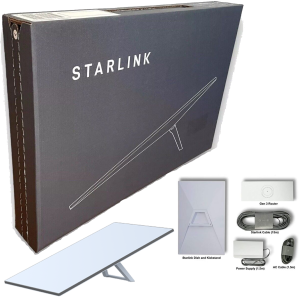
At its core, Starlink’s technology is what sets it apart. The system comprises:
- Satellites: Thousands of LEO satellites form a “mesh” network, constantly handing off connections as they orbit Earth. This ensures consistent coverage, even in motion (via mobile plans).
- User Terminal (Dish): Nicknamed “Dishy,” this phased-array antenna auto-aligns with satellites. It’s weather-resistant (IP67-rated) and compact, fitting on roofs, poles, or vehicles.
- Router: A Wi-Fi 6 device that supports up to 235 devices, covering up to 297 square meters.
- App Integration: The Starlink app provides real-time diagnostics, obstruction checks, and easy setup.
In Kenya, this translates to download speeds of 50-250 Mbps (up to 1 Gbps in optimal conditions) and uploads of 5-25 Mbps. Latency averages 25-40ms, rivaling fiber and far surpassing GEO satellites (600-800ms). For comparison, Safaricom’s 5G offers similar speeds but only in select urban spots, while rural users might get just 10 Mbps on 4G.
Starlink’s self-healing network minimizes downtime—satellites deorbit responsibly to avoid space debris, and ground stations in Africa ensure low-latency routing. In Kenyan contexts, this means farmers in Kitale can monitor IoT crop sensors without lag, or lodges in Maasai Mara can offer guests seamless Wi-Fi amid the wilderness.
Starlink vs. Traditional Providers: A Clear Winner
To understand why Starlink reigns supreme, let’s compare it to Kenya’s main ISPs:
| Feature | Starlink | Safaricom (Fiber/5G) | Airtel (4G/5G) | Zuku (Fiber) |
|---|---|---|---|---|
| Coverage | Nationwide, including remote areas | Urban/peri-urban focus | Nationwide but patchy rural | Urban only |
| Speed (Download) | 50-250 Mbps | 50-500 Mbps (urban) | 5-150 Mbps | 50-300 Mbps |
| Latency | 20-40ms | 10-30ms (fiber) | 30-80ms | 10-30ms |
| Reliability | High, satellite-independent | Prone to outages/cuts | Congestion-dependent | Stable in coverage areas |
| Cost (Monthly) | KES 1,300-32,000 | KES 2,500-12,500 | KES 1,000-5,000 | KES 2,200-4,999 |
| Setup | DIY or pro (under 1 hour) | Days to weeks | Instant (SIM) | Installation required |
| Portability | Yes (roaming plans) | Fixed | Mobile | Fixed |
Starlink excels in coverage and portability, crucial for Kenya’s mobile workforce and rural entrepreneurs. While fiber is faster in cities, it’s unavailable in 70% of the country. Mobile networks like Airtel suffer from data caps and congestion—Starlink’s unlimited plans (e.g., Residential at KES 6,500/month) provide freedom without throttling.
In real tests (as per CAK reports), Starlink users in rural Marsabit report 150 Mbps, outpacing local 4G’s 20 Mbps. During power outages, Starlink pairs well with solar backups, unlike tower-dependent mobile services.
Sector-Specific Benefits: Transforming Kenyan Lives
Starlink’s versatility makes it indispensable across sectors:
Education
With over 10 million students in rural areas, online learning was hampered pre-Starlink. Now, platforms like Eneza Education and Elimu TV reach Garissa or Wajir seamlessly. Teachers conduct virtual classes with 25ms latency, and students access global resources. In 2025, Starlink-connected schools in Nyeri report 30% improved exam scores due to better e-learning.
Business and Startups
Kenya’s Silicon Savannah thrives on connectivity. Startups in Nairobi use Starlink for cloud computing and global collaboration, while SMEs in Mombasa expand e-commerce via Jumia. Businesses report 40% productivity gains, per a 2025 Reisen SEO study. For cybercafés, Starlink’s business kits (KES 8,000/month) offer prioritized data, outshining congested mobile hotspots.
Healthcare
Telemedicine bridges gaps in remote areas. Doctors in Turkana consult specialists via low-latency video, sharing records in real-time. Starlink powers IoT devices for patient monitoring, reducing travel needs. A 2024 study shows 25% fewer emergency referrals in Starlink-equipped clinics.
Agriculture
Farmers in Murang’a check market prices and weather via apps, boosting yields by 20%. IoT tools for soil monitoring work flawlessly, and online sales platforms connect producers directly to buyers.
Tourism and Entertainment
Lodges in Amboseli provide guests with high-speed Wi-Fi, enhancing reviews. Gamers enjoy lag-free play, and streaming (Netflix at 4K) is buffer-free. For off-grid adventurers, roaming kits (KES 14,000/month) keep them connected.
Testimonials abound: A Lodwar cybercafé owner says, “Starlink turned my 4G struggles into 200 Mbps bliss,” while a Makueni teacher notes, “No more frozen classes—education is now equal.”
Pricing and Packages: Affordable and Flexible
Starlink’s pricing has evolved to suit Kenyan budgets. As of September 2025:
- Residential Lite: KES 1,300/month for 50GB (25-100 Mbps) – Budget-friendly for light users.
- Standard Residential: KES 6,500/month unlimited (50-220 Mbps) – Ideal for families.
- Business: KES 8,000-32,000/month with priority data – For SMEs.
- Roam/Mobile: KES 14,000/month unlimited inland – For travelers.
- Mini Kit: KES 4,000/month deprioritized unlimited (up to 100 Mbps) – Portable option.
Hardware starts at KES 27,000 for the Mini Kit, down 55% from 2023’s KES 89,000. Rentals at KES 1,950/month make it accessible. Compared to Safaricom’s KES 2,500 for 45GB, Starlink offers better value for heavy users.
Local resellers enhance affordability: Starlite Internet Kenya offers flexible payments and financing, while Spacelink Kenya bundles with solar kits for off-grid areas.
Installation and Support: Local Expertise Matters
Starlink’s DIY setup is simple—unbox, app-guided alignment, online in minutes. But for optimal performance, professional installation is key. Certified teams assess sites, mount dishes securely, and integrate mesh networks.
Authorized providers shine here:
- Starlink Kenya offers certified installations for KES 200-500, with 24/7 support and 12-month warranties.
- Spacelink Kenya specializes in extensions like signal boosters for estates, ensuring perfect alignment.
- Starlite Internet Kenya provides 1-hour Nairobi delivery and pro setups, with recent installations at hospitals and universities.
These partners offer nationwide delivery, flexible payments, and maintenance, making Starlink hassle-free. The Starlink app handles activation, with support tickets resolved in hours.
Challenges and How Starlink Overcomes Them
No service is perfect. Starlink’s upfront cost (KES 27,000-350,000 for kits) can deter some, but rentals and price drops mitigate this. Obstructions like trees require clear skies—installers help with mounts. Heavy rain may cause minor dips, but LEO tech recovers quickly.
Regulatory hurdles, like data privacy concerns, have been addressed through local partnerships. Unlike competitors facing cable theft or tower failures, Starlink’s satellite redundancy ensures uptime.
The Future of Starlink in Kenya
Looking ahead, Starlink plans more satellites for faster speeds (up to 10 Gbps) and direct-to-cell integration with mobiles. Partnerships with Karibu Connect and government initiatives align with Kenya’s Digital Economy Blueprint. By 2030, Starlink could connect 90% of rural Kenyans, boosting GDP by 1-2%.
Conclusion: Starlink’s Enduring Edge
In 2025, Starlink isn’t just an alternative—it’s the best option for Kenya’s diverse needs. Its nationwide coverage, blazing speeds, low latency, and sector-transforming impact outshine traditional providers. With affordable packages, easy access via resellers like Starlite Internet Kenya, Spacelink Kenya, and Starlink Kenya, and a robust support network, Starlink empowers Kenyans to thrive digitally.
Ready to connect? Visit these resellers for kits, installations, and more. Starlink isn’t the future—it’s Kenya’s connected present.
